Laos – Si Phan Don 4000 Islands – Wild River Relaxation

22 Aug 2019

Sleepy and relaxed does not even begin to describe southern Laos’ Si Phan Don or more popularly referred to as the “4000 Islands” – albeit nobody actually ever counted them.

Cruising between islands

Laos is not a super big country but it is a very long country, so instead of spending two days on a bus we decided to jump on a quick one hour flight from Luang Prabang to Pakse. A quick night stopover in Pakse got us on an early two hour-ish bus ride to Ban Nakasong where you jump on a bumpy traditional long tale boat for the quick set over to Don Det.

Don Det is probably the most touristic (and easiest to get to) island of Si Phan Don but by all means not actually very big or overdeveloped. In fact you won’t find any cars on the island, just scooters, a few tuk tuks and many bicycles which you can rent on every corner to get you around the bumpy roads on the island. To give you an idea of size (and bear in mind this is one of the biggest of the islands), we walked around the whole island (not very fast since it was nearly 40 °C) in around two and a half hours with a few pit stops in the shade in true island mentality.

Powerful Li Phi Falls

We stayed at a riverside bungalow with a private bathroom and breakfast included at less than £10 a night, what a bargain! Most accommodation on the island is in bungalow style, there are some differences in price depending on shared/ private bathroom, size and cleanliness – but note almost none of the accommodations have an aircon unit and it gets hot! Oh so very hot!

Refreshing dip in the Mekong!

Staying here in early April you can expect temperatures of just under 40°C, not that bad you might say if you’re an experienced traveller, but here in landlocked Laos you have no remedy from an ocean breeze, actually no wind at all and it is super humid – you just won’t stop sweating! Combine that with no aircon in your little bungalow and you certainly know what it means to be hot beyond compare, so if you’re struggling with heat, maybe Laos in April isn’t the right choice for you. But if you’re willing to give it a try, rest assured that you can always take a dip in the Mekong river to get a little refreshment and we recommend to opt in for a bungalow with private bathroom so you can cool down in the shower whenever you want.

Sun set on the Mekong

The charm of the 4000 islands lies in a combination of super relaxed island vibes and the gorgeous wildlife. Expect to wake somebody up from their slumber in a hammock if you go into a shop or restaurant (don’t be shy, the locals are always happy about the business). On several occasions we wandered into a shop to pick up a few things to see one of the neighbours getting onto their mobile to call the shop keeper who eventually came cruising in on a scooter or bicycle, so take you time, don’t rush and don’t expect anyone else to rush. The lady from our accommodation always disappeared for 5-10min after taking our breakfast order, one day we asked her why and she explained that she had to go to their backyard to find the fresh eggs that her chickens had laid – can’t get more organic “farm to table” than that!

Fishing trip!

On every corner you’ll meet chickens with little chicks, duck with little ducklings, puppies, kittens, free roaming water buffalos, butterflies and (unfortunately) masses of bugs (they are especially a nuisance when it’s dark and the light are on) – but to be fair there weren’t that many mosquitos around. On the note of mosquitos though, come prepared, check the malaria status for the region, most times of the year it is advised to take anti-malarial tablets (great website for this and many other useful travel tips for all destinations is the NHS Fit For Travel website!).

Catch of the day!

If you’re used to island hopping in any other South East Asian country you’re probably expecting a beach and a dip in the ocean – in Laos this is replaced by lush green jungles and a dip in the Mekong river, very different but also beautiful! Just keep in mind that swimming in the Mekong comes with risks, the currents are very strong in parts, there are certainly a bunch of animals and plants you’re not familiar with (think water snakes and freshwater reeds) and the water is muddy brown so you don’t have great visibility – but don’t be scared, just don’t go alone (and never at night), make sure you don’t go further than you can stand and wear water shoes and everything will be fine!

Busy cruising around the island

On Don Det you can also rent tubes (big floating tires) that carry you on the current around the island! Super fun but make sure you either go with a group (and a guide) or you know for sure where you have to paddle towards land and get out otherwise you might be in trouble – if you survive the (not recommended) ride down the upcoming waterfall after Don Det you might just end up in Cambodia with nothing but your bikini, explain that to border control! But again, don’t be afraid, just be prepared and if all goes wrong the sleepy locals are quick to help! We saw an American lady floating much further than intended and not being able to get to shore – the locals spotted her straight away and the local fishermen had her on their boat in no time!

We had a really nice fishing trip with Nak, our accommodation “dad”, cruising along the Mekong and trying different fishing spots, caught a few catfish and enjoyed the beautiful sunset.

On this note you can also rent a Kayak but for the same reason we would recommend booking a tour with a guide.

Li Phi Falls

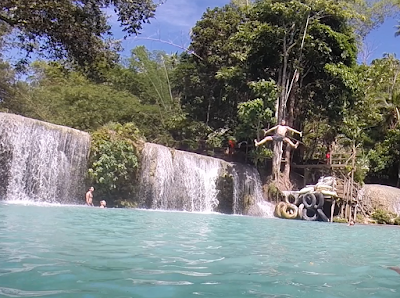
Visiting the beautiful Li Phi Falls was one of our highlights and just showed us again how magical Laos is! Rent a bicycle for the day at around 10.000 Lao Kip (just over 1 Euro!) and cruise over the bridge to the neighbouring Don Khon island, then it’s just a short ride to the magical waterfalls! Go for a dip in the river before heading to the view point to cool down from your bike ride and don’t forget to drink enough water on the journey, it’s not a particularly hard ride to get there but don’t underestimate the heat and humidity getting to you, it can catch you off-guard!    

These fellows also struggled with the heat

We certainly enjoyed island life in this magical place and can only recommend you add Laos to your bucket list, it was definitely our “surprise” country having enjoyed it so much more than expected and totally fell in love with it!

Night out in Vientiane

A quick lay over in Vientiane – not super spectacular (as per my earlier post, always choose Luang Prabang over Vientiane if you can only do one), nice seafood and a good night out though – gets us on our way to busy Bangkok! Meet us there (virtually) next time!

Laos – Luang Prabang – Hidden Magic in the Mountains

17 June 2019

Traditional barge on the Mekong River

A short flight from Hanoi gets us into the heart of Laos: The beautiful ancient UNESCO heritage site Luang Prabang! Situated at 700 metres above sea level and lined by mountains as well as the Nam Khan and Mekong River the location of the town itself is breath-taking – Add an array of stunning temples, well preserved colonial architecture and bustling traditional markets and you have something very special and magical indeed.

If you ever have to choose between visiting Luang Prabang or Vientiane because you’re short on time and/or budget, choose Luang Prabang! Hands down, there is no question about it, don’t miss out on this beautiful gem!!!

View from Mount Phousi

Compared to most of its neighbours Laos is still very traditional and laid back, even though easy enough to get around and plenty of accommodations across tourist spots, it’s never really crowded and we haven’t come across any “tourist factory skyscraper hotels” anywhere in the country. This might be due to Laos being landlocked and not having any beaches, but we very much enjoyed our time in this less travelled treasure trove of beauty and can highly recommend it!

Start of Kuang Si Falls

There is unbelievably not one McDonald’s or Burger King to be found in the whole country or any real food chains for that matter. Which means you’ll eat at traditional family run restaurants with home cooked meals – sounds amazing, and it mostly is, but note that there is always differences in quality and price (often the cheaper rustic places have the most amazing food), we found TripAdvisor is a good source for reviews to decide on which restaurants to try.

Traditional craft at the Night market

Also there are no Seven Eleven shops in Laos and often the shanty shops close early (or really don’t have any real opening times at all, closing time depends on the mood of the owner and what’s on telly that evening), so get your essentials like water and the emergency pot noodle and biscuits early on and make sure you’re well stocked just in case.

Ancient Tree

Luang Prabang’s historical centre itself is not very big, stay anywhere near the night market and you have lots of options for food and drinks, note though that this is not a party town and bars usually close before midnight. Pretty much at any given time of the day (except late night) there is a street market open somewhere in town. From getting fresh fruit and veg at the morning market, over choosing your lunch at the day markets’ many food stalls to doing some shopping for authentic handmade souvenirs followed by a fruit smoothie at the night market – you certainly won’t be bored, if you like markets, but even if you don’t there is plenty of other things to enjoy!  

Right in the middle of town you’ll find Mount Phousi, a fairly short hike up to the temple at the top gives you amazing views of the Mekong and the surrounding mountain range – especially beautiful (but also a lot more crowded) during sunset.

The “very busy” main road in Luang Prabang

You can also book a tour or make your own way by boat to the Pak Ou Cave temple filled with Buddha statues or jump on a boat taxi to the stunning botanical gardens.

A very traditional part of Luang Prabang is the Alms giving ceremony that happens early every morning.

Heralded by sunrise gongs from neighbouring temples the procession of monks walk their daily route through town to collect offerings such as food and flowers, even as a Westerner you are allowed to take part, just make sure you bring an offering, keep a respectful distance (this is not a selfie opportunity!) and take your shoes off while kneeling.

Beautiful Kuang Si Waterfalls

But the one thing you should definitely not miss are the beautiful Kuang Si Falls! Voted one of the top ten most beautiful waterfalls in the world it definitely makes our number one (and we’ve seen a fair few beautiful ones across Asia). Over multiple levels the cascades of water and shallow so very blue pools set in the rainforest backdrop are not only stunning to look at but also super refreshing to swim in! We made our way there on a scooter we rented for the day but there is some dangerous driving and we recommend for scooter novices to get there (easily enough) with an array of jeepney taxis (just head anywhere in town to find them and they’ll ask if you want to go). Just make sure to bring some time to really relax and enjoy the scenery, you can sit and just stare at the big waterfall at the end for ages, wild butterflies all around, the little droplets making a rainbow when the sun catches it just right – it is a truly magical place and had us totally enchanted.

Mount Phousi summit

On your way to (or from) the waterfalls head to the Kuang Si Butterfly Farm just around the corner, a lovely little animal farm (obviously mainly butterflies as the name suggests). It is run by a nice Dutch couple that dedicated their lives to protecting the environment with butterflies playing a very important role in the local eco system. All profits from the entrance fee go to building education centres for the locals teaching them how to live sustainably, protecting the environment and how best to recycle. Totally worth a visit and have a good chat with the owners, they have great stories to tell! 

At the Butterfly farm

Luang Prabang is truly a special place and we hope that it will continue to stand the test of time and keep to its traditional roots to preserve its magic!

We’re off to explore the island group “4000 islands” in the Mekong next – meet us there!

Vietnam – Hanoi – Golden Turtles, Ancient Legends and Fooooood

21 May 2019

From Ho Chi Minh City we took a quick flight to Hanoi. Only having the 14 day visa waver meant we were a little limited on time and focused our Vietnam trip on those two cities for now.

At Dong Xuan Market

Hanoi is Vietnam’s capital and after Ho Chi Minh the second largest city. It is not as much a modern metropolis as Ho Chi Minh but instead impresses with its charming French colonial-era buildings and heaps of history. Tree lined boulevards, opera houses, little bakeries and coffee shops – with all the French influence it is no surprise that Hanoi is often referred to as Paris of the East. Having been to Paris myself I have to say Hanoi certainly has a little je ne sais quoi of the French capital but it is sprinkled with a healthy portion of Vietnam’s flavours: little alleys, lots of scooters and delicious street food! It makes for a wonderful combination!

Flowers at Hoan Kiem Lake

We stayed in a lovely little homestay called Hoan Kiem Homestay situated close to Hoan Kiem lake and not too far a walk from the old quarter. The homestay is in a charming old colonial building, the rooms have a cute balcony, the croocked floor boards squeak with history and from the rustic kitchen windows on the top floor you can just about imagine to catch a glimpse of the Eiffel tower (which of course you can’t) – it all adds to the authentic feel of the homestay and Eric the host was super friendly, welcoming and just as authentic as his homestay!

There is a lot of things you can do in Hanoi, from temples to shopping to heaps of history to explore.

Hot Pot! Yummy!

Maybe the most famous, at least for Vietnamese and Chinese tourists is the Ho Chi Minh Mausoleum modelled after Lenin’s Mausoleum in Moscow. In true communist fashion Ho Chi Minh’s embalmed body is preserved here and laid to rest. We heard queues for the entry are long no matter what time of the day (or year for that matter) you go, as many people travel here to pay their respects. From our cultural background’s point of view we felt the whole scenario a little macabre and decided not to add to the long queues and skip visiting Uncle Ho.

The heart of historical Hanoi is Hoan Kiem lake meaning “Lake of the Returned Sword”. According to 15th century legend Emperor Lê Lợi returned his magic sword (after fighting off a Chinese invasion with it) to the Golden turtle god who appeared to the him in the lake. To this date you can still find fresh water turtle species in Hoan Kiem lake which have been released in the lake as a sign of appreciation for the Golden turtle god. From the shore you can walk over the red bridge titled “Welcoming Morning Sunlight Bridge” and visit the Temple of the Jade Mountain in the middle of the lake.

Hoan Kiem lake, bridge and temple at night

Walking around the lake, taking in the flower arrangements, picking up some fresh fruit from the small vendors, visiting the temple, trying to spot a turtle and just lazing on one of Hoan Kiem lakes’ many benches, it makes for a nice half-day visit – or even full day, depending on how fast you walk, how much you eat and how long you laze around for.

Probably the most famous part of Hanoi is the Old Quarter, here the French influence mixed with Vietnamese tradition is at its most powerful. Dong Xuan Market and surrounding shops boasts with whole areas dedicated to specific products – clothes, fabric, spices, fruit, veg, meat, fish – you name it, they have it – we even found a street dedicated to biscuit shops!

Bit of spice, anyone?

The Tuyen Pho Di Bo Walking Street leading through the heart of the old quarter has much of the same craziness as its Ho Chi Minh counterpart Bui Vien walking street: little plastic chairs, cheap beer, good food and a lot of people! Again, if you’re not a fan of crowds you should not attempt to walk down this road, especially in the evening. We were actually glad that our accommodation was a little outside the Old quarter as it just gets so very busy. We did have a great time on our night out at Tuyen Pho Di Bo Walking Street, made some amazing new friends and ended up in a Rock club miles away from our accommodation – which was also super fun and I’d love to tell you more about it, but my memory is (very strangely) a little blurry on that part… might have been the Jägermeister, who knows, it’s a mystery!

Let’s get cooking! Mushroom and Beef option with fresh veg to make your own spring rolls

Now, we’ve always been big fans of Thai food and have been known to cook our own Thai red curries and Pad Thai, so don’t get me wrong we still love it but I have to honestly say: Move over Thai food, there is a new favourite in town!!! The Vietnamese cuisine really is an explosion of flavours from the classic Pho noodle soup (Pho Bo being the beef and Pho Ga the chicken option), over the most amazing combinations for spring rolls, to fresh savoury Banh Mi baguette ending at our personal favourite the hot pot with endless delicious options – every dish we’ve had in Vietnam has been amazing and worth every penny! So if there’s a Vietnamese restaurant near you folks in the West, give it a try and skip the trusted Chinese or Thai take-away just once, you won’t be disappointed! 

Drinks at Tuyen Pho Di Bo Walking Street

We leave Vietnam with our bellies full and with the promise to return to spend more time in this beautiful country – For now we’re off to Laos! See you in Luang Prabang y’all!

Vietnam – Ho Chi Minh City – Skyscrapers, Alleys and Coffee

09 May 2019

View from Bitexco Financial Tower, the “Stark Tower”

A quick ferry ride from Koh Rong island (Cambodia) gets you back to Sihanoukville, here you can catch a bus to many locations. We decided to go to Vietnam’s Ho Chi Minh City next. The 27 US $ per person 14 hour sleeper bus first gets you back to Phnom Pen at which point you’ll have to change for a different bus that gets you over the border into Vietnam and all the way to Ho Chi Minh. Sounds fairly easy and the sleeper buses are almost comfortable (and you save a night on accommodation) but if you, like me, get food poisoning the morning of your travel from a dodgy omelette and fighting the urge to throw up (on a bus with no toilet) and dealing with massive stomach cramps the whole journey, it certainly isn’t that much fun. The border crossing from Cambodia to Vietnam was pretty straight forward and we got our 14 day visa waver approved, no questions asked, which made the trip a little easier.

Uncle Ho’s Walking Street

After my nightmare journey from hell we finally arrived early morning in Ho Chi Minh City (often abbreviated to HCMC)almost on time. Our awesome friends Sam (yes, another Sam) and Ella which we met on Cebu in the Philippines are English teachers in the local schools in Ho Chi Minh and have a lovely apartment with roof top pool in District 3 – and best of all, they let us crash on their sofa and we didn’t have to wait hours for check in time after a very long day and night indeed – total life savers!

Uncle Ho in front of City Hall

Ho Chi Minh City, or often still referred to as Saigon, is Vietnams biggest city and a fast growing commercial metropolis. You see a lot of skyscrapers lining Ho Chi Minh’s modern skyline, probably most famously the Bitexco Financial Tower, often nick named the “Stark tower” because it served as inspiration for Tony Stark’s headquarters in the Iron Man and Avengers films. Only five years ago the Stark Tower was the country’s tallest building, next year it will be its fourth tallest, a true sign of the city’s rapid growth. At 262 meters height and 68 floors it houses, next to a mix of shopping mall and office spaces, the very posh EON Heli Bar on the 52nd floor (with its own helicopter landing pad, yes it’s that posh!). Here you can get fantastic views of the city, especially at night. Note though that you have to buy a very expensive drink if you want to actually enjoy these views, or if you’re on a tight budget pretend to be studying the menu, get a few snaps and make a quick exit.

Snuck in for a quick pic

The super modern Ho Chi Minh City is in stark contrast to what we felt is the true heart of Saigon: Its many tiny winding alley ways with small stalls, tiny restaurants and cute little coffee places. At this point I have to mention that I find a lot of things are ruined by setting expectations too high, if somebody tells me something is super-duper great and it ends up being just good, I end up being more disappointed than if somebody tells me something is just okay and it actually turns out to be good. Same thing, both good, but it feels different due to expectations – which gets me to Vietnamese coffee: Being told by many people back home and during our travels, I thought the praise for Vietnamese coffee was just an overrated hype, but no it actually is the best coffee I’ve ever had, hot or cold, from a boutique café, street vendor or even from the corner shop – it is always super delicious! Set your expectations high, you will not be disappointed!

Dream team ready to rumble at Bui Vien Walking Street!

Sam and Ella really made our time in the city special, from Uncle Ho’s walking street, the Stark Tower, night markets, Bui Vien, meditation at the pagoda, long walks by the river, chilling on the roof terrace and splashing in the pool, we had such a blast. To top it all off it was amazing to have a kitchen to cook in and the walk-in shower was such a treat (it’s the little things you miss) – nice homecooked food in the evening (who knew I liked soy milk and tofu so much!) washed down by a few (or sometimes many) ciders and beers – perfection! Thanks again you guys for having us! HCMC wouldn’t have been the same without you!

In District 1 you’ll find Nguyen Hue Street or lovingly referred to as Uncle Ho’s walking street, only a stone’s throw from the Stark Tower stretching from City Hall to the Saigon river. Markets are not far from here, street vendors selling all sorts of snacks and souvenirs, lots of little boutique bars lining the street and an array of performing street artists – it makes for a nice leisurely walk in the early evening. Don’t forget to say hi to Ho Chi Minh/ Uncle Ho in his statue version in front of City Hall!

View from the 52nd floor of the “Stark Tower”

However if you’re after cheap drinks and a party atmosphere head down to the Bui Vien walking street, also located in District 1. It is not for you if you don’t like crowds (especially in the evening) or if you’re an upmarket traveller but it is heaps of fun. Lined with tiny bars equipped with even tinier red plastic chairs it has its very own charm, drinks are so very cheap (potentially the cheapest in the city) and you can pick up some decent street food in every bar. The later the evening, the crazier it gets, if you’re in a rush getting anywhere, do not walk down this road. Even though it’s classed as a walking street you will (of course, like everywhere in Vietnam) encounter a million scooters and sometimes even a car or two driving in between the pedestrians and trying to force their way through the mass of people. This is not made easier when the bars continue to extend their space by adding tables further and further out onto the road to make the driving/ walking space even smaller. Grab yourself a little red chair, order a drink and just enjoy people watching – it is so much fun and really adds to the vibe of the city. We certainly had a blast (and a terrible hangover the next day)!

The little red chair gang! Bui Vien Party time!

Another hidden gem that Ella introduced me to was visiting the local Pagoda which opens its doors to anyone who is interested in experiencing Buddhist traditions and customs. They welcome everyone to join in with the signing and meditating and even offer an array of delicious vegetarian food for free. They were all so very welcoming and friendly and the meditation was really insightful (despite the Lotus position not being the most comfortable and it being very hot – but hey, just meditate it away). It’s a great way to connect with the locals and other travellers alike and was a fantastic experience, I would highly recommend trying it out! (Meanwhile Sam and Sam were down by the river catching cat fish and making friends with the local fishermen).

Evening stroll by the river

For us it hadn’t been too long since we had some beach time but Sam and Ella really wanted to escape the city for a quick weekend trip. Vung Tau beach, reachable in just 1-2 hours by car (depending on traffic), is a popular spot for a quick get-away, however we heard that the beach gets very busy and is quiet polluted, so we thought we’d spend the weekend in a less touristic area just down the road called Long Hai.

At the Pagoda

Well, let’s just say our weekend beach dreams were left unfulfilled, the waters were very brown and the beach horribly dirty (sewage being pumped straight into the ocean, we didn’t even want to go for a swim despite it being unbearably hot). Besides the beach there is not really anything else to do either, so we cut our visit short and decided we’re better off chilling back in HCMC on the rooftop. In our opinion Long Hai is not worth the trip to the coast, invest your budget elsewhere! 

But we had a wonderful time in Saigon and really enjoyed exploring the city with Sam and Ella’s expertise, see you around the globe soon you two! For now we’re off to Hanoi!

Cambodia – Koh Rong – Hidden Beaches and Luminous Waters

05 April 2019

Sok San Village

After travelling to Manila, Hong Kong, Siem Reap and Phnom Pen we felt that it was time for some well-deserved beach time away from cities, so we travelled from Phnom Penh down to the Cambodian coast in the south to catch a ferry to Koh Rong.

The 10 US $ minivan was a similar experience to the bus from Siem Reap to Phnom Pen – timing was bad (and we again arrived much later than expected, taking 10 hours instead of the promised 7 hours) and the ride wasn’t super comfortable – but again it was very cheap so we can’t complain. The ferry goes from Sihanoukville, a very up and coming town with its own beach, albeit not even close to being as beautiful as Koh Rong – do yourself a favour and don’t settle for Sihanoukville’s tourist factories and catch the ferry to the island, you won’t regret it.

Scooter time! Exploring the island’s hidden treasures

Koh Rong is an island with many faces, probably best known for its crazy party scene in backpacker central Police Beach on the Koh Touch part, but there are many other less well known locations on the island where you can really get away from it all. We decided to stay in a sleepy fishing village called Sok San Village, with a handful of restaurants and bars and affordable accommodation we felt right at home (try the Pizza and the Falafel place if you need a break from curries and rice). The village is on Long Beach and makes for a chilled atmosphere with a hand full of tourists and lovely locals. Long Beach itself is (you guessed it) pretty long, a stretch of 7km wonderful white sand where you can walk to your heart’s desire to take in the natural beauty of it all.

Pit stop – Are we going the right way?

Besides relaxing, topping up your tan and swimming, there is not a hell of a lot to do in the village, which suited us fine but if you want to explore a little further you can rent a scooter for a day or go for a 10 US $ per person day trip.

With its many peers and jetties Sok San Village makes for a great fishing spot and after some trial and error and some helpful tips from the locals Sam caught some decent size fish that we BBQ’ed right on the beach – dinner is served! Yummy!

Beautiful Palm Beach

We were glad we went to explore the island on a scooter as it really has some hidden gems. The drive itself through the islands beautiful scenery was a great experience. Just be careful with some of the bumpy roads, these scooters are not made for some of the tracks and we had to get off and push from time to time. A short (bumpy) ride from Sok San Village leads you to Palm Beach which is really stunning, crystal clear blue water and stretches of sand banks makes you feel like you’re in paradise. There are only a handful of (fairly expensive) accommodations at Palm Beach and it’s not easy to get there by boat from the mainland which is why many tourists don’t go there but it really is worth a visit! Whenever we have a little more in our travel budget we’d definitely stay here and soak in the natural beauty.

Playing at Palm Beach

Another great discovery was Coconut Beach (a slightly longer drive from Sok San Village through the island) which also impresses with beautiful white sand and wonderful water. It is a little busier than Palm Beach offering a few choices for restaurants and bars, we went to the Thai restaurant on the beach and it was great food at a good price.

Catch of the day! But this little fella went back into the ocean, just too small for dinner

The 10 US $ day trip offers you an array of activities from snorkelling, fishing, beach BBQ, sunset cruise and luminous plankton at night it sure is a busy day. We enjoyed it and can’t complain for the price however note that the snorkelling is nice but not amazing (compared to other destinations in South East Asia), the beach BBQ only happens if you catch enough fish (which we didn’t) and you might be a little peckish come sun down. We really did enjoy swimming in the luminous plankton though, it was very pretty and so much fun making the water around you light up, like making your own special effects! Unfortunately it is impossible to pick it up on any camera, so you’ll just have to go experience it yourself to see what it looks like. It was a little creepy at first jumping into the dark water in the middle of the ocean, but once you see the glow underwater you’ll quickly forget the creepiness.

Beach BBQ!

At this point I need to mention that unfortunately Cambodia is still a little behind its neighbours when it comes to recycling and waste management. Due to the currents and tides the waters right at Sok San Village are full of plastic and all other sorts of rubbish. We cleaned up the beach for hours pulling an incredible amount of plastic out of the ocean and were happy to see other western tourists starting to do the same. Unfortunately it seems the locals don’t care much and don’t have the same sense of urgency when it comes to preserving the oceans and trying to lower the use of plastic. While Vietnam has posters all over its cities explaining how to recycle, in Laos you see water refill stations all over the place (sponsored by a great movement called Trash Hero) and in the Philippines you’ll struggle to find a plastic straw – Cambodia is still a little careless about what gets thrown into their oceans, we hope they will catch up soon with positive influence from their neighbours!  

Swing at Palm Beach

But Koh Rong really has something to offer for everyone’s tastes and budgets and is a great place to get to know the relaxed Cambodian island culture, we suggest you’ll find out for yourself next time you’re in this neck of the woods!

For us it’s back to cities for now, watch out Ho Chi Minh City, here we come!

Cambodia – Phnom Penh – The Horrors of History

25 Mar 2019

Take a stroll through Phnom Penh’s many parks

You can get to Phnom Penh from Siem Reap in a quick one hour flight, but if (like us) you’re on a budget it is much cheaper to jump in the bus at a bargain US $ 6 per person. Just set your expectations low, the bus is not super comfortable, the scheduled travel time of 6 hours ended up being nearly 9 hours, there is no communications on breaks (and no toilet on board) and the bus is partially used as goods transportation (expect to share your luggage space with boxes of goods and worst case scenario some chickens, sounds funny but they do smell a bit after a while). But hey, who can complain for 6 US $!

Route so far – Phnom Pen

Phnom Penh is a capital like many others in South East Asia, temples and markets and a beautiful Royal Palace. Restaurants and bars will keep you well fed and watered and accommodation is not badly priced.

But what Phnom Penh may be the most memorable for is its fairly recent history. Having been completely “evacuated” by the Khmer Rouge regime in 1975 under the false pretence of expected American bombings. In reality the day marked the end of the civil war and the rise of Marxist dictator Pol Pot, the leader of the Khmer Rouge. He ordered the clearing of Phnom Penh as part of his plan to empower the working class and to re-build Cambodians as a “master race”. He relocated citizens from the cities into work camps which were disguised as farming communes, all private property was banned and the Cambodian currency was abolished. In Pol Pot’s distorted vision of Cambodia, everybody should be equal and there was no need for money and property. His brutal regime reigned through terror from 1975 to 1979, according to UNICEF’s estimation, around 3 million people were killed through executions and starvation, that’s 25% of the population – 1 in 4 Cambodians died in just four short years.

Memorial shrine at Choeng Ek killing fields

Cambodians killing Cambodians – Pol Pot mistrusted everyone, in particular educated citizens but he also targeted religious groups such as monks and nuns. With slogans like “better to make a mistake and kill an innocent than letting an enemy live” nobody stood a fair chance.

His re-education centres were disguised torture and execution camps and hardly anyone made it out alive. In the infamous S21 Prison many people were tortured until they confessed to crimes and treason against the regime that they didn’t commit. Many prisoners didn’t make it to the execution camp but died during torture. From the estimated 15,000 to 30,000 prisoners only 7 survived.

Lake at the killing fields – it’s been decided that the victims in the graves below the water should be left to rest undisturbed

The Choeng Ek killing fields located 15 km outside Phnom Penh was one of the biggest execution centres with around 129 mass graves holding an estimated 20,000 victims remains, but many have not yet been excavated.

In 1979 the Vietnamese army invaded Cambodia, they were able to beat the Khmer Rouge and removed Pol Pot from power. Pol Pot escaped to the rural northeast of the country where he was supposed to be tried for his crimes against the state but died during his house arrest in 1998 at the age of 72, an age that so many of his victims weren’t even close to reach before he cut their lives short.

One of many mass graves that has not yet been excavated

We felt that we needed to see the Choeng Ek killing fields and the S21 Prison, now known as Tuol Sleng Genocide Museum, for ourselves. It felt disrespectful to spend a month in Cambodia and not give this part of their history the attention and time it deserves.

When entering the killing fields you can feel the mood changing, this is not a “fun touristy selfie” place, it is a place to learn about history, acknowledge the horrors the country had to endure and show respect for the victims. On entry you receive an audio tour which has been put together very well, mixing the historical facts with survivor stories which really gives you great insight and even the toughest of us will find it hard not to get emotional. When following the audio guided tour make sure you stay on the designated path, a lot of the mass graves have not yet been fully excavated and it is common to see old clothes, bone fragments or even teeth of the victims just off the path – do not pick any of it up but alert one of the officials on the site.

Killing fields Memorial shrine

To save ammunition most executions were carried out with tools that happened to be available, such as farming tools, blunt clubs or machetes.

The most gruesome part in our opinion was the Killing Tree. Pol Pot was of the opinion that if you kill a parent you should also kill the children as to not leave anybody behind that could seek vengeance. The Killing Tree was used to smash infants skulls against it for a quick death that didn’t cost any resources such as ammunition. The bodies were then thrown in the mass graves with their mothers.

Prison cells at S21

The tour ends at the big memorial shrine in the centre where a lot of victims’ skulls have been put to rest. 

The S21 Prison/ Tuol Sleng Genocide Museum also provides an audio tour at a little extra charge. We got a little squeezy looking at the too well archived pictures of the victims, many of which had to be censored as they were too gruesome. It is an eerie place and you can only imagine the horrors the victims had to go through by looking at the torture apparatuses.

The killing tree now covered in prayer bracelets

The visit to the Killing fields and S21 is not something we will ever forget. It’s really a day that will stay with you and takes a while to digest, but we feel that if you visit Cambodia you should not skip such an important part of what makes the country today. Think that this was only 40 years ago, every Cambodian over 40 will have some sort of memory of the events, a story to tell and most likely a lost loved one to remember. The least we can do about it as tourists is learn about the country we visit and to show our respect.

Cambodia – Siem Reap – Say Wat? Angkor Wat!

20 Mar 2019

Sunrise at Angkor Wat

In just under three hours you can fly from Hong Kong to Cambodia, Siem Reap. Hong Kong Express offers quick, efficient, comfortable and budget friendly options.

Why did we go to Siem Reap? Yes, you guessed it, Angkor Wat has been on our bucket list for a very long time and we couldn’t wait to finally see it in person!

Drive from Angkor at to Angkor Thom

When entering Cambodia make sure you have US $ ready for the visa on arrival (you can also pre-arrange it online, but it’s pretty hassle free on entry as well). Bear in mind that visas can only be paid in cash, so if you don’t have any US $ on you, use the ATM in the immigration hall (before you start queuing!). Visa (for UK and German citizens) is 30 US $ per person for 30 days, if you pre-arrange it in advance online with an agency they will charge you more due to their own fee, we would suggest you save your pennies and get a visa on arrival. Note that they will give you not exactly 30 days but stamp your passport the same date you enter for the next month, i.e. entering on the 10th of February our exit date was 10th of March (so they short changed us by two days).

The Cambodian currency is called Riel, however you’ll get much further with US $. Sadly the Riel these days is only used for small transactions. The prices in all shops, restaurants and accommodation will be displayed in US $ – all transactions are made in US $, the only tricky part is that they only have notes and no coins, meaning the lowest amount you can carry in US $ is the 1 Dollar note. This hiccup is solved with the Cambodia Riel where 1000 Riel equal 0.25 US $ – are you confused yet? We certainly were when we first arrived, but it’s fairly simple once you get used to it. Say your bill is 5.50 US $, you’ll pay with a 5 Dollar note and a 2000 Riel note.

Angkor Wat reflected in the lake

Not having done any research on Siem Reap before turning up we somehow expected a very different vibe from a town that is the entry point to everything Angkor Wat related. We remembered our time in Kandy, Sri Lanka, which holds the sacred Buddha tooth artefact in the logically named Tooth temple, the vibe in Kandy was deeply religious and peaceful – bars close at 11pm latest, locals and tourists alike have an air of respect for the religious and historical sites around them.

Water Lily in front of Angkor Wat

So considering Angkor Wat is the biggest historical and religious site in all of Cambodia (if not all of Asia), an ancient and mysterious place, even featured on their flag – stands to reason that Siem Reap has a similar vibe to Kandy, right? Not.In.The.Slightest!

Siem Reap is such a party town that you will have trouble getting a good night’s sleep if you’re staying near the centre – 24h bars blasting music, drug dealers on every corner and the cheapest beer in the country – we certainly didn’t expect that! To us it seemed such a stark contrast to the attraction of Angkor Wat that we were a little thrown by it.

Our hostel Garden Village Guesthouse which we chose because it is centrally located and has a pool, was so overcrowded with young backpackers constantly drunk and/or high that it didn’t make for a great atmosphere. I overheard a young western girl telling her friend that she wanted to go see Angkor Wat but spent all her money on a night out, her mum was nice enough to transfer more money so she could go see it and she again spend it on booze and drugs and was busy photoshopping herself into google pictures of Angkor Wat to send to her mum, she thought it was hilarious… we thought it was disgraceful – to be so close to this monumental attraction just to spend all your (and your mums) money on partying rather than go see something many people would give their right arm to experience.

Walk through Ta Prohm
One of many hidden walkways

Well, what can I say, she missed out one of the most stunning places I’ve ever experienced and I’m sure will regret it in future! Angkor Wat is a vast temple complex spanning on more than 162 hectares, that’s nearly an unbelievable 230 football fields – the sheer size of the whole Angkor Archaeological Park is immense, but the temples is what will make you feel in awe. It is hard to fathom how people had the tools to achieve such greatness as early as the 12th century when the constructions began. 

Angkor Thom’s Bayon smiling rock faces

We opted in to go for the sunrise at Angkor Wat and found a tuk tuk driver who was willing to pick us up, take us from temple to temple and then bring us back home, for a bargain US $ 15 for the day. The ticket office is actually not directly at the temple gate, so if you’re trying to make your own way there by scooter or bicycle, make sure you stop at the ticket office first. The one day ticket is priced at a staggering US$ 37 per person, but the money is used for maintenance and upkeep of all the temples and it’s really not something where you want to prioritise budget over experience. There are also different price categories for more than one day, if you really want to take your time (depending on how much of a history buff you are).

Ta Prohm ancient tree and even more ancient rock

Considering it’s a 4.30am start to catch the sunrise it was already very busy in the morning, but who can blame everyone for trying to get the best view of the changing lights and magical glow during sunrise. Don’t let the masses of tourists impact you, just enjoy the views – and they were amazing! (Note though, take a flash light and insect repellent and keep in mind this is a religious site so wear appropriate clothing covering your knees and shoulders)

When visiting the different temples throughout the day you can only marvel at what kind of effort and craftsmanship has gone into the constructions so many years ago. Originally built as a Hindu temple during the rule of the Khmer Empire, Angkor Wat was slowly transformed into a Buddhist temple by the end of the 12th century. With its iconic shape featured on the Cambodian flag, everybody can recognise it straight away. But don’t underestimate the beauty and impressive features of the other temples in the complex!

Huge tree at Ta Prohm

Angkor Thom’s Bayon temple for example, even though smaller than Angkor Wat, has beautiful detailing in its repeated rock statue faces making it an impressive sight in its own right.

But Ta Prohm was our personal favourite, the ancient trees entangled into the temple structure give it a captivating and compelling atmosphere, it’s hard to believe that the temple itself is so much older than the giant trees growing through it – it really is something very special.

Enchanting Ta Prohm

If you can only do one thing in Cambodia due to budget and/or time we recommend Angkor Wat, you really shouldn’t miss it!

Next we’re off to Phnom Pen – see you all (virtually) there!

Hong Kong – Hello Piggy! Happy Chinese New Year!

17 Mar 2019

View of Central from Tin Hau

We flew out from Manila to Hong Kong on a quick four hour Air Asia flight – the first impression of Hong Kong already happened in the air before we arrived!

We were seated next to a lovely girl from Hong Kong and she straight away struck up a conversation about where we should go, what we should see, what we should try to eat and she was so excited to share the inside tips of her home we couldn’t help but getting even more exited for our one week stay for Chinese New Year!

So very busy!
Festive red lanterns across the city
Entrance to Temple Street

It’s always been a dream to spend Chinese New Year in Hong Kong, however we found it’s a double edged sword of sorts. Celebrating the arrival of the year of the pig 2019 has been a whirlwind of busy streets, bright events and tourists, tourists and even more tourists.

You will experience all the New Year festivities such as the bright fireworks, colourful parades, dragon costumed staff entertaining tourists across the city, red Chinese lanterns illuminating the streets, New Years’ markets blooming with beautiful flowers and bustling with locals and tourists alike.

However if you want to get a feeling for the real Hong Kong we’d advise to consider going a different time. The streets and MTR’s are much busier than normal, still bearable due to the great infrastructure, but certainly busy – however all the tourist attractions are so ridiculously swamped that you will not be able to go see them or even if you do make it, will not very much enjoy them as they will be so overcrowded.

Colourful dragons welcoming the New Year

Hong Kong’s number one tourist destination Victoria Peak (or just “The Peak”) is reachable by tram or with the less iconic transport option by bus – however the queue to the tram tickets was estimated at a staggering three hours which would only give you the ticket, you then also need to queue up for the tram itself, to which the staff could not even estimate a waiting time – and bear in mind you’d need to get down from the Peak somehow also – queuing for hours again I guess?

New Years market blooms

Even pre-booked tickets had a waiting time of two hours just to be able to collect them. Despite Hong Kong being generally very well organised, the amount of tourists was definitely too much to handle for the staff and it was a complete mess – half the people didn’t even know what they were queuing for and there was not enough info.

Trying to get a bus was equally as impossible as the queue was already so long the staff were telling us that there would not be enough buses running during the day to even take the people up that were currently waiting – absolute madness!

Unfortunately we had similar experiences at the other attractions like Big Buddha – just too busy!

With a population of around 7.5M people, Hong Kong’s tourism board estimates tourist visitor numbers during the Chinese New Year celebration at around 1M –  so it’s no surprise it’s all a little crazy. Prices for accommodation increase dramatically during this period and are often booked out, so get your reservations in early if you feel Chinese New Year in Hong Kong is a must!  

Sea weed wrap, yummy!
New Years Fireworks

We stayed at a lovely airbnb apartment hosted by very helpful and friendly French architect Baptiste with our own kitchen! Most of you will not understand the feeling of luxury you get when you finally have a fridge available! It’s really the small things in life you miss most as a backpacker. Views were great, location was great, host was great – we really felt at home!

Hong Kong is such an interesting city with so much to offer – modern yet never lost its historical and cultural soul, great vibes, friendly locals and so many different places to discover!

Just one of many talented artists across the city
Hidden treasure

We feel like we want to come back again to experience more Hong Kong vibes away from the Chinese New Year craziness and take our time exploring this amazing city!

For now though we are off to Cambodia – Happy Chinese New Year everyone! Oink Oink!

Philippines – Kayaking the clouds in Dumaguete and family time in Cavite

14 Mar 2019

Dumaguete

We opted in for a quick stay in Dumaguete located on Negros island before making our way back to Manila. Just a quick 1 hour-ish ferry ride from Siquijor it was too close to miss it completely.

Kayaking in the clouds at the twin lakes
The lakes hidden in the mountains

Dumaguete city is certainly very busy even though not as busy as Cebu city or Manila. It has a nice beach promenade with stalls, bars and restaurants called Rizal Boulevard which makes for a nice stroll early evening followed by a few cold ones.

Beautiful nature

From Dumaguete city you can visit the Manjuyod Sandbar often referred to as “the Maldives of the Philippines” by scooter, bus or tuk tuk – it is a beautiful stretch of white beach in the middle of the ocean that only appears early morning and sometimes in the afternoon (depending on season). The locals have built authentic wooden huts selling fresh seafood and drinks. We hear it’s worth a visit if you can get up there early enough to be sure not to miss the right tide, unfortunately we missed it due some heavy rains on the day – better luck next time they say.

Taking in the views

Luckily we did get to see the Twin Lakes, Lake Balinsasayao and Lake Danao. We rented a scooter in Dumaguete city and (avoiding rush hour) it’s only around 20min on the main road until you take the picturesque path up the mountain to the lake – take your time to enjoy the views, don’t rush in the tight turns and you can appreciate the stunning nature of the Cuernos de Negros mountain range on your way up.

Kayak time!

When you arrive you can either get ferried across to the second lake or rent a kayak – since we had plenty of time and really wanted to explore we rented the kayak and enjoyed circling around the first lake in our own time and then headed to the viewing platform between the two lakes. The lakes are super clear and the rich forest surroundings add to the otherworldly atmosphere so high up the mountain. We enjoyed seeing the clouds come in when kayaking back, it felt as if we were in a different universe surrounded by water, forest and clouds – certainly couldn’t have felt further away from grey London weather and busy trains.

Cavite

Family portrait

After flying from (tiny) Dumaguete airport to Manila (with Philippine airlines, comfy flight and free luggage allowance!) we stayed in the city for a few nights and then finally got to meet Sam’s little half brothers and sister in Cavite!

Catch of the day

Cavite is a fast growing province south of Metro Manila, we were heading to General Trias and although it is only around 35km away from central Manila this translates to an unbelievable two to three hours’ drive in crazy Philippine traffic. Like many places near cities in the Philippines it boasts with multiple malls with all the western and non-western shops you can imagine and also has quite a few local supermarkets as well as the (much cheaper) public market.

Cavite is a fast growing province south of Metro Manila, we were heading to General Trias and although it is only around 35km away from central Manila this translates to an unbelievable two to three hours’ drive in crazy Philippine traffic. Like many places near cities in the Philippines it boasts with multiple malls with all the western and non-western shops you can imagine and also has quite a few local supermarkets as well as the (much cheaper) public market.

We stayed with Magda (Sam’s fathers wife) and Sam’s half-siblings in their lovely home. Magda was so very hospitable and welcoming giving us the five star guest treatment with yummy home cooked meals, introductions to all extended family, friends and neighbours and just made us feel very welcome – home away from home really!

Girl power! What a catch!

We had a great time exploring Cavite away from the tourist tracks and enjoyed swimming in the local natural pools and waterfalls, going to the cinema with the siblings and had a great time fishing as well as BBQing and eating the catch there and then – who knew tilapia was so delicious?!?

We had a great time and will definitely be back to visit again in future!

A few hours bus ride and a quick four hour flight gets us to our next adventure – Hong Kong for Chinese New Year!!

Philippines – Siquijor – Witches, Shamans and Ghosts

15 Feb 2019

Sunset at Siquijor

The Spanish colonials often referred to Siquijor as Isla del Fuego, the island of fire – this was apparently due to the magic red glow the coast line would have during dusk which was actually due to a mass of fireflies roaming the beaches at certain times of the year. Siquijor is an island surrounded by myths, it is said to have witches, voodoo and magic! Sounds intriguing? We thought so too and had to investigate ourselves!
Siquijor is a tiny island in between Cebu, Negros, Bohol and Mindanao (and note that it is realistically the farthest south you should safely travel in the Philippines as a tourist with Mindanao not advisable to visit). During our visit in January 2019 Siquijor still had a very unique charm to it, not many tourists roam the streets, you’ll find a handful of restaurants and accommodation around the San Juan area which are very budget friendly compared to the more touristy spots on Bohol, Cebu or Palawan. For now there is a certain “still a secret” vibe to it and the mythical stories you hear from the locals certainly add to the authentic atmosphere of the island – however we saw many building sites and new developments in the making during our stay and we hope against hope that Siquijor doesn’t lose its special charm to overdevelopment like Alona Beach on Bohol has.

Salagdoong beach

As there are limited facilities on the island especially in terms of healthcare (i.e. there is no hospital) many locals rely on their traditional healers such as herbalists witches, mananambal, albularyo and shamans, most of which practice curing of ailments with a mix of herbal potions and faith healing such as chakra cleansing. Siquijor according to the witches is the best place to gather all the special medicinal herbs needed to practise effective healing magic. While I don’t doubt that herbal remedies can be very effective I’d personally draw the line when it comes to buying love potions (but hey, each to their own).

We got here with a quick 1 hour 40 min ferry ride from Bohol which was a little bumpy at times but nobody got sea sick. Siquijor’s biggest (albeit not very big) city is also called Siquijor with multiple ferries coming and going on a daily basis. We found that the region (you can’t really call it a city) of San Juan is the most charming, with a handful of restaurants, bars and shops.

Busy chilling…

We stayed in a budget double room at John and Lheas’s beach cottages which has direct access to the ocean and nice snorkelling. Owner and staff were very friendly, we could use the well equipped kitchen and rent a scooter from them for a good price. We actually ended up staying longer than expected because we liked it so much and got an even better rate after a bit of haggling (just over 8 Euros per night for private room with private bathroom, a bargain!)
If you’re looking to party the night away your options are very limited here although there is one great open air style party every Friday at Czars place to which the locals and travellers across the whole island flock alike (just be careful with pickpockets! Sam nearly had his wallet stolen but luckily his cat like reflexes prevented the culprit to get away with it!).

Ocean selfie!

Best way to explore the island is by scooter, rates are cheap for a day and even cheaper if you want a scooter for longer and the roads are not busy at all. It’s a certain feeling exploring the island in your own way and taking your time with beautiful spots and hidden treasures you stumble across. The island really only has one main road circling the island so you can’t really get lost and you can easily cover half of the island in an unrushed 1.5 hours driving time.

Sam “swinging” at Cambugahay falls

As long as there is enough rainfall the waterfalls are great to explore (in dry season some of them are out of water). When at Cambugahay falls take a dip to cool down and pay a few pesos to use the rope swings into the falls, all surrounded by natural beauty – it’s really something you shouldn’t miss!

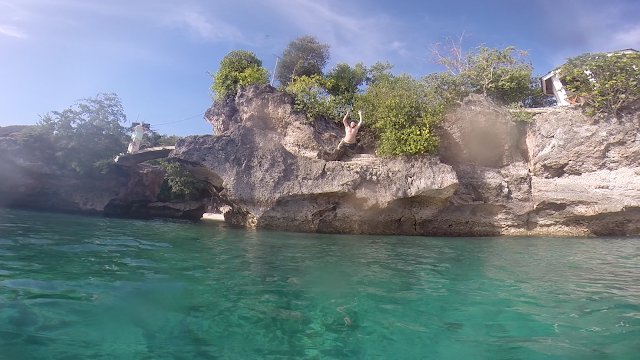
When you circle the island further you get to Salagdoong beach which isn’t just impressing with its nice stretch of beach and crystal clear waters but also has some fun cliff diving if you’re not feint hearted. Check with the locals on the tides and depth of water before committing yourself to literally jump of a cliff! We estimated the highest jump to be around 15 meters – and fortunately or unfortunately (depending which way you see it) the water wasn’t deep enough at our tim
e of visit so we had to skip this one – we had great fun jumping off the lower cliffs though at around 5-7 meters!

The jump!
I still hear my mums words: “If your friend would jump off a cliff…” – mum, I am that friend!

We enjoyed a lovely evening with our friends having a traditional Filipino style meal with many different dishes to try – one of our friends that we met on Bohol is an amazing cook and spoiled us with squash, aubergine and papaya salads, freshly BBQ’ed tuna and (not to be missed at any Filipino meal) mountains of rice – yummy!!

Home-made Filipino food – amazing!

During our visit a new myth was the talk of the town and all over the local news – apparently a ghost ship was spotted by the coast guard vanishing into the thick fog, it can be seen some nights between midnight and 1am but once you get a glimpse of it, it disappears!
We unfortunately weren’t lucky enough to spot it. There are three explanations to this in my opinion:

1. Some locals invented the ghost ship and with Siquijor’s mythical vibe it got blown out of proportion

2. The coast guard did see a ship and started pursuing it but lost track of it in the fog and as not to be in trouble with their superiors they said it was a ghost ship and it vanished
Or 3. There really was a ghost ship and we just didn’t have the luck to catch a glimpse of it – needless to say I prefer option number three and feel that if there is a place where this could happen it would be the Isla del Fuego – magical Siquijor!

Check back here for our adventure to the twin lakes on Dumaguete!